Collection Kit Overview
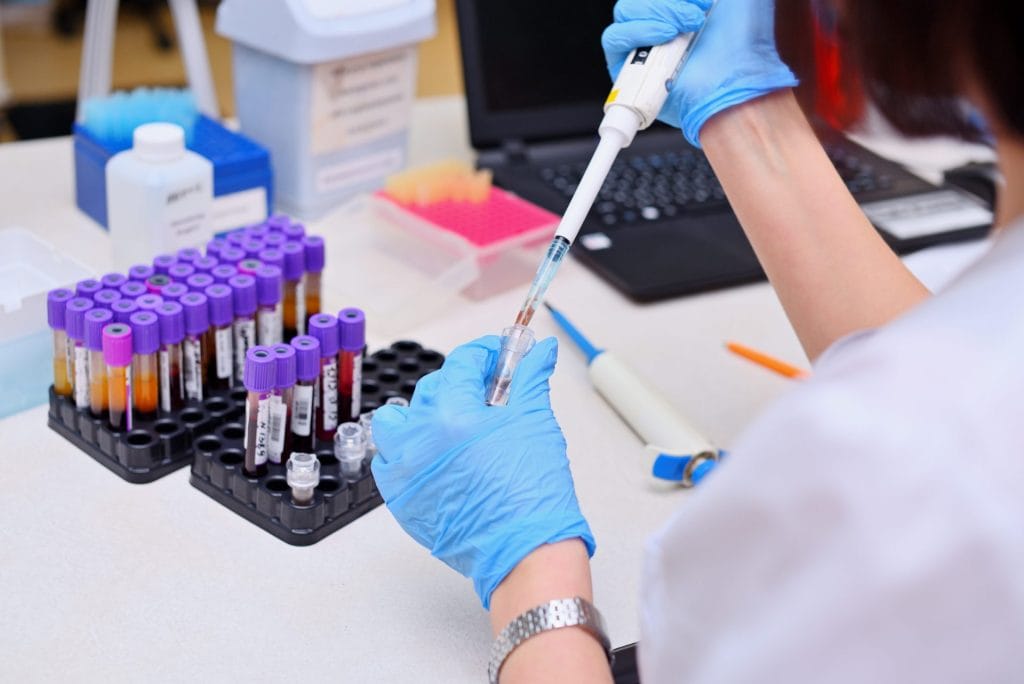
The DS-Biorepository central lab will provide pre-designed and assembled biospecimen collection kits to collection sites. Each kit is designed for a single participant, and the materials provided in the kit are barcoded such that the kit ID barcodes will be linked to the participant of that kit.
It is IMPERATIVE that barcoded sample collection tubes are not mixed between kits, used with different participants, or different participant visits. For example, if a barcoded kit is used for a participant, every barcoded tube from that same kit must be used for the same participant and same collection visit or discarded after the visit is done. This ensures that the biorepository can properly track samples from a given participant visit. The only exceptions are the Child/Adult Supplement kits and the Replacement Component kits which do not contain individually barcoded collection tubes. An overview of each collection tube can be viewed in the Collection Kit Quick Reference Guide in the appendix.
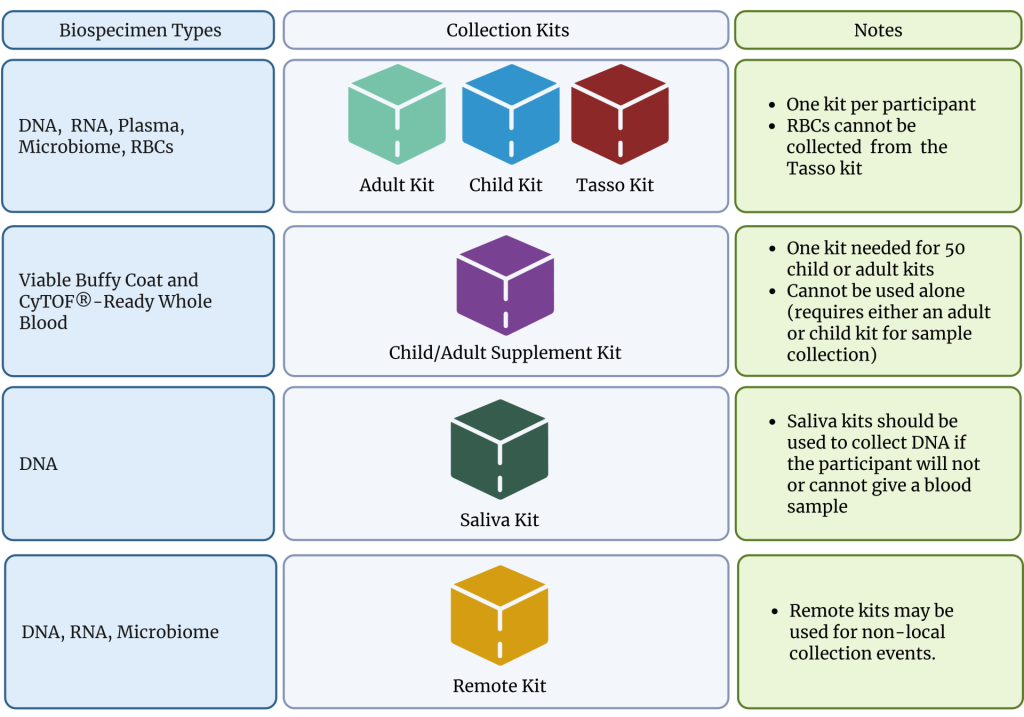
The following tables provide an overview of the intended participants. Detailed collection protocols for each kit can be reviewed in the Biospecimen Collection section.
Collection Kit Demographics and Description
Tasso, Child, Adult, Saliva, Remote Collection Kits
| Patient Demographics | Tasso Kit | Child Kit | Adult Kit | Saliva Kit | Remote Kit |
| Weight requirement (kg) | 3+ | 5-11 | 11+ | 0+ | 5+ |
| Maximum blood draw (mL) | 1 | 10-22 | 22-46 | N/A | 5 |
| Age (Approx. years) | 0+ | 0-10 | 10+ | 0+ | 0+ |
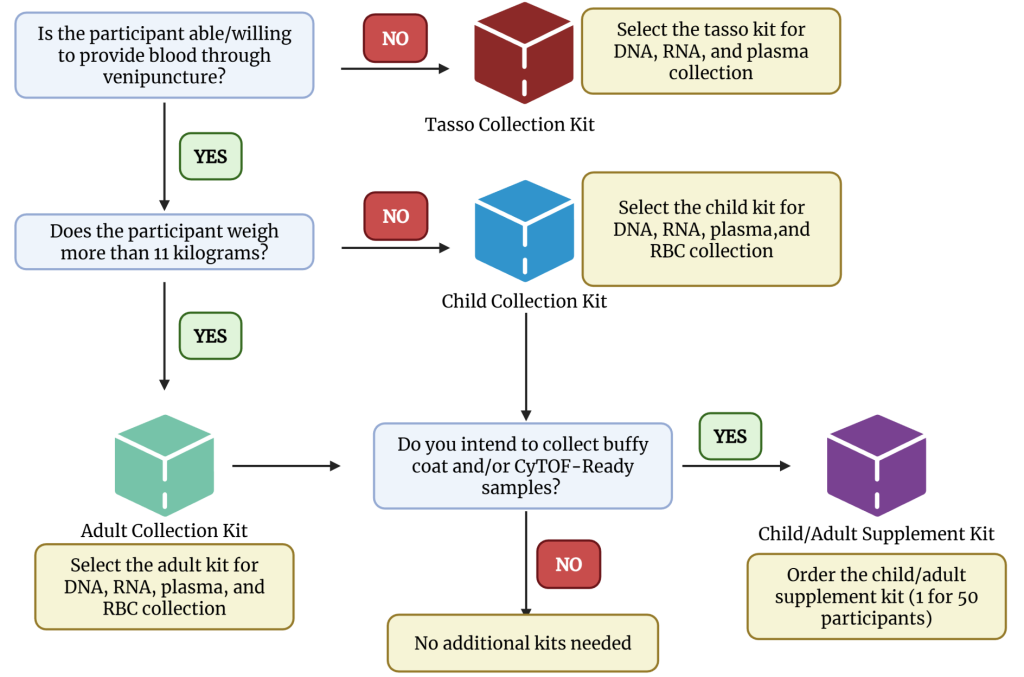
The preferred collection kits are the Child and Adult kits, which ensure harmonization between sample collections and that enough sample volume can be collected for prospective research uses. The Tasso device kits are only intended for use in cases where a participant is unable or refuses to provide blood through venipuncture. The Tasso kits will yield a maximum of 1 mL of capillary blood. The Child and Adult kits provide materials for collecting multiple blood vacutainers. Not every vacutainer must be used to fulfill the minimum required samples. Safe blood draw maximums are determined by participant weight. The volumes above reflect 2 mL/kg/day. The saliva kit is an optional standalone kit that will enable collection of saliva as a backup source for DNA. The preferred source of DNA for all participants is blood.
Remote collection kits may be used for non-local participants who cannot provide samples directly to the research sites. These kits allow for collection of DNA and RNA through venipuncture as well as microbiome through tongue swabs. Collection of DNA and RNA will require as phlebotomist to perform a blood draw. The DS-Biorepository will provide the Remote kit to research sites, but the research sites will be responsible for coordinating remote collection events. After collection, the Remote kit samples should be returned to the collection site. These samples should then be batch shipped back to the DS-Biorepository as outlined in the shipping instructions.
Replacement Component Kit
The replacement components are meant to be used if either a biospecimen collection tube (EDTA vacutainers, PAXgene® tubes, tongue swabs) or a biospecimen storage tube (15 mL conical of plasma, plasma matrix tubes, RBC matrix tubes, CyTOF®-ready microcentrifuge tubes, or buffy coat cryogenic vials) are damaged and need to be replaced. The replacement kit supports replacing tubes from the Tasso, Child, or Adult kits. Since the collection and storage tubes from each kit are barcoded with kit IDs, which are tied to specific collection events, any replacement tubes needed must come from this kit rather than any of the other collection kits.
If a tube needs to be used from the replacement kit, the collection site should track this event using the replacement kit form. On this form, indicate the kit ID and tube ID of the tube(s) that need to be replaced, and the tube ID(s) used to replace it. Attach a copy of this form to the kit specimen form used for biospecimen collection and processing. When both the kit specimen form and the replacement form are returned to the DS-Biorepository central lab with the biospecimens, the central lab will update the biospecimen tracking logs to include the replacement tube IDs as part of the specific collection event they were used for.
Child/Adult Supplement Kit
These supplement kits are designed to provide labs with additional materials required for use with the Child or Adult kits. These materials facilitate the collection of cryopreserved buffy coat and CyTOF®-ready samples. These materials include temperature-sensitive reagents, such as Fetal Bovine Serum (FBS), which are shipped separately for logistics. Each supplement kit contains enough materials for 50 participant visits. The reagents are NOT participant or visit-specific and are intended for use during the blood processing steps of either the Child or Adult Kits.
Kit Requests
Kits may be requested in advance through the DS-Biorepository website using the kit request portal. Alternatively, if the kit request portal is inaccessible, requests may be made via email to the DS-Biorepository Staff. Multiple kits may be ordered in advance; however, collection sites should consider their anticipated enrollment schedules, as many of the kit components have a shelf life of 6 months.
Kit Storage
Tasso, Child, Adult, Saliva, Replacement Tube Collection Kits
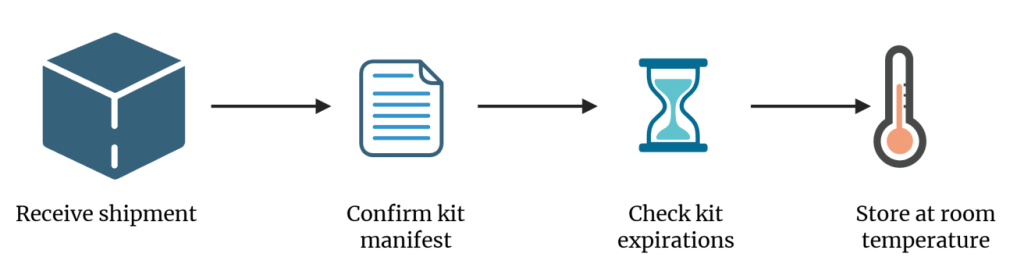
- Store kit contents at room temperature.
- For kit requests in the U.S. Return shipping labels will be provided based on the number of kit requests. Collection sites should store the return shipment labels in a safe location until needed for return samples. For international sites, return shipping labels will be provided through the World Courier.
Child/Adult Supplement Kit
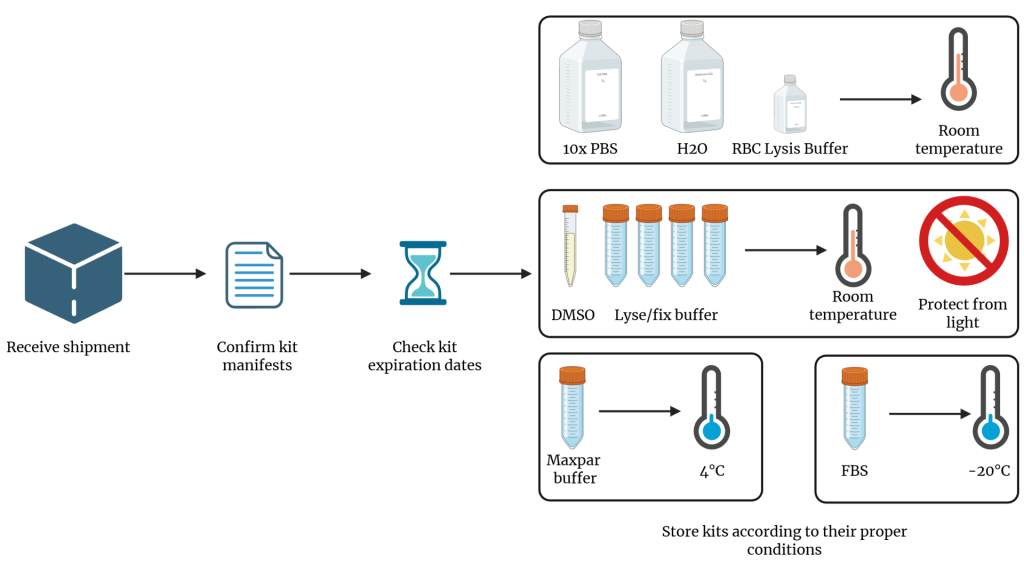
- Store 10x PBS, H2O, and RBC Lysis buffer at room temperature.
- Store DMSO and 5x Lyse/Fix buffer at room temperature, protected from light.
- Store Maxpar® buffer at 4°C.
- Store FBS at 4°C for short-term (<1 month) or -20°C long-term.